Read
Books and other resources that have shaped my thinking.
Books I Love
History of Ideas, Technology & Society
The Dream Machine: J.C.R. Licklider and the Revolution That Made Computing Personal
“There was this thread of ideas that led from Vannevar Bush through J. C. R. Licklider, Doug Engelbart, Ted Nelson, and Alan Kay—a thread in the Ascent of Man. It was like the Holy Grail. We would rationalize our mission according to what Xerox needed, and so on. But whenever we could phrase an idea so that it fell on this path, then suddenly everybody’s eyes would light up, and you’d hit this resonance frequency.”
Take graphics, for example: everybody resonated with graphics. They had Alan Kay right there, after all, constantly preaching his gospel of computers as the most richly expressive medium humans had ever known—and more to the point, showing them his group’s prototype font editors, drawing programs, on-screen document windows, and iconic programming systems. It was living proof of what you could really do with computer graphics. They likewise had Gary Starkweather and his laser printer: living proof that you could build up any image you wanted just by arranging tiny dots on a piece of paper—or on a computer screen. And they had the living example of Doug Engelbart’s NLS. “You got this feeling sitting in front of one of Doug’s screens, and looking at his displays, that the computer image was as good as paper,” says Lampson. “And that was a revolutionary idea at the time.” In the electronic office, whatever that turned out to be, the computer screen would have to be able to display text, diagrams, formulas, annotations, doodles—anything paper could display.
On the other hand, it’s even easier to imagine scenarios in which that history might have played out very differently indeed—scenarios in which those hobbyist computers would stay in their garages for a very long time, for example, while microchips mainly went into building bigger and more powerful centralized machines. Technology isn’t destiny, no matter how inexorable its evolution may seem; the way its capabilities are used is as much a matter of cultural choice and historical accident as politics is, or fashion.
So in the end, about all anyone can really say is that it’s hard to play “What if?” with history. What we do know is that in our history, J. C. R. Licklider had the vision. He was given the opportunity to realize that vision. He seized that opportunity. And he succeeded beyond anything he could have hoped for.
- The Singularity Is Near: When Humans Transcend Biology
- A New History of Western Philosophy vol. 1-4
- Philosophy of Science: A Theoretical and Historical Introduction
- Inventing Temperature: Measurement and Scientific Progress
- Plato's Ghost: The Modernist Transformation of Mathematics
- The Prize: The Epic Quest for Oil, Money, and Power
- Chip War: The Fight for the World's Most Critical Technology
- The Scaling Era: An Oral History of AI, 2019-2025
21st Century Monetary Policy: The Federal Reserve from the Great Inflation to COVID-19
Ultimately, of course, the administration and Congress, through legislation, set the Fed’s goals, structure, and authorities. The cornerstone of congressional oversight of the Fed’s monetary policy, formally laid out in the Federal Reserve Reform Act of 1977, is the so-called dual mandate: Congress’s instruction to the FOMC to pursue the economic goals of maximum employment and stable prices. Although the Fed’s monetary policy objectives are enshrined in law, Fed policymakers are responsible for managing interest rates and other policy instruments to achieve those objectives. In a distinction popularized by Stanley Fischer, the Fed does not have goal independence—its objectives are set by the president and Congress, through legislation—but it does have, at least in principle, what I’ll call policy independence, the ability to use its policy instruments as it sees fit to best achieve those mandated goals. Various aspects of the Fed’s structure—including the long, overlapping terms of governors; the provision that governors cannot be fired by the president for policy differences; the fact that Reserve Bank presidents are not political appointees; and the Fed’s ability to pay for its operations out of the returns from the securities it owns rather than relying on congressional appropriations—help insulate it from short-term political pressures, allowing it to act more independently than Cabinet departments and with a greater focus on longer-term outcomes.
In practice, central-bank guidance varies on many dimensions. Federal Reserve Bank of Chicago President Charles Evans and Chicago Fed economists Jeffrey Campbell, Jonas Fisher, and Alejandro Justiniano, in a 2012 paper, introduced the useful distinction between Delphic and Odyssean forward guidance. Delphic guidance (after the oracles at the Temple of Apollo at Delphi) is intended only to inform, to help the public and markets better understand policymakers’ economic outlook and provisional plans for policy. In short, Delphic guidance is an economic and policy forecast by the central bank (or, perhaps, by an individual policymaker), not a promise or commitment to take any particular action. In contrast, as Odysseus bound himself to the mast to avoid the temptations of the sirens, Odyssean* guidance attempts to bind policymakers to a metaphorical mast by stating a *commitment, or at least a very strong predilection, to conduct policy in a specific way in the future.
Mathematics, Computing & AI
Gödel's Proof
The basic feature of mapping is that an abstract structure of relations embodied in one domain of “objects” can be shown to hold between “objects” (usually of a sort different from the first set) in another domain. It is this feature which stimulated Gödel in constructing his proofs. If complicated meta-mathematical statements about a formalized system of arithmetic could, as he hoped, be translated into (or mirrored by) arithmetical statements within the system itself, an important gain would be achieved in facilitating meta-mathematical demonstrations. For just as it is easier to deal with the algebraic formulas representing (or mirroring) intricate geometrical relations between curves and surfaces in space than with the geometrical relations themselves, so it is easier to deal with the arithmetical counterparts (or “mirror images”) of complex logical relations than with the logical relations themselves.
Gödel’s proof should not be construed as an invitation to despair or as an excuse for mystery-mongering. The discovery that there are number-theoretical truths which cannot be demonstrated formally does not mean that there are truths which are forever incapable of becoming known, or that a “mystic” intuition (radically different in kind and authority from what is generally operative in intellectual advances) must replace cogent proof. It does not mean, as a recent writer claims, that there are “ineluctable limits to human reason.” It does mean that the resources of the human intellect have not been, and cannot be, fully formalized, and that new principles of demonstration forever await invention and discovery. We have seen that mathematical propositions which cannot be established by formal deduction from a given set of axioms may, nevertheless, be established by “informal” meta-mathematical reasoning. It would be irresponsible to claim that these formally indemonstrable truths established by meta-mathematical arguments are based on nothing better than appeals to intuition.
- The Annotated Turing
Machine Super Intelligence
The strong emphasis on learning, adaptation and experience in these definitions implies that the environment is not fully known to the individual and may contain new situations that could not have been anticipated in advance. Thus intelligence is not the ability to deal with a fully known environment, but rather the ability to deal with some range of possibilities which cannot be wholly anticipated. What is important then is that the individual is able to quickly learn and adapt so as to perform as well as possible over a wide range of environments, situations, tasks and problems. Collectively we will refer to these as “environments”, similar to some of the definitions above.
Bringing these key features together gives us what we believe to be the essence of intelligence in its most general form:
Intelligence measures an agent’s ability to achieve goals in a wide range of environments.
We take this to be our informal working definition of intelligence for this thesis.
The foundations of universal intelligence date back to the origins of philosophy and inductive inference. Universal artificial intelligence proper started with the work of Ray J. Solomonoff in the 1960’s. Solomonoff was considering the problem of predicting binary sequences. What he discovered was a formulation for an inductive inference system that can be proven to very rapidly learn to optimally predict any sequence that has a computable probability distribution. Not only is this theory astonishingly powerful, it also brings together and elegantly formalises key philosophical principles behind inductive inference. Furthermore, by considering special cases of Solomonoff’s model, one can recover well known statistical principles such as maximum likelihood, minimum description length and maximum entropy. This makes Solomonoff’s model a kind of grand unified theory of inductive inference. Indeed, if it were not for its incomputability, the problem of induction might be considered solved. Whatever practical concerns one might have about Solomonoff’s model, most would agree that it is nonetheless a beautiful blend of mathematics and philosophy.
4.1.3 Definition. The universal intelligence of an agent is its expected performance with respect to the universal distribution over the space of all computable reward-summable environments , that is,
The final equality above follows from the linearity of and the definition of as a weighted mixture of environments. It shows that the universal intelligence of an agent is simply its expected performance with respect to the universal distribution.
Consider how this equation corresponds to our informal definition. We need to measure an agent’s ability to achieve goals in a wide range of environments. Clearly present in the equation is the agent , the environment and, implicit in the environment, a goal. The agent’s “ability to achieve” is represented by the value function . By a “wide range of environments” we have taken the space of all computable reward-summable environments, where these environments have been characterised as computable chronological measures in the set . Occam’s razor is given by the term which weights the agent’s performance in each environment in a way that decreases according to its complexity. The definition is very general in terms of which sensors or actuators the agent might have, as all information exchanged between the agent and the environment takes place over very general communication channels. Finally, the formal definition places no limits on the internal workings of the agent. Thus, we can apply the definition to any system that is able to receive and generate information with a view to achieving goals.
We have shown that there does not exist an elegant constructive theory of prediction for computable sequences, even if we assume unbounded computational resources, unbounded data and learning time, and place moderate bounds on the Kolmogorov complexity of the sequences to be predicted. Very powerful computable predictors are therefore necessarily complex. We have further shown that the source of this problem is the existence of computable sequences which are extremely expensive to compute. While we have proven that very powerful prediction algorithms which can learn to predict these sequences exist, we have also proven that, unfortunately, mathematical analysis cannot be used to discover these algorithms due to Gödel incompleteness.
Computation Structures
When I started learning how to code, I was amazed at what it could do. However, I was also unsatisfied because the computer seemed like a black box to me. As a physics enthusiast, I always have this urge to explore the underlying principles of a system. This course by Chris Turman uses a bottom-up approach to introduce how to design computer architectures, programming languages, and operating systems, and it was very enlightening to me at the time.
Software Design
Magic Ink: Information Software and the Graphical Interface
Information software serves the human urge to learn. A person uses information software to construct and manipulate a model that is internal to the mind—a mental representation of information. Good information software encourages the user to ask and answer questions, make comparisons, and draw conclusions. A person would use recipe software, for example, to decide what to cook for dinner. She would learn about various dishes (where “learning” could be as informal as a quick skim for something tasty that contains ingredients on hand), compare her options, and make her decision. In effect, she is constructing an internal understanding of culinary possibilities, and mentally prodding this model to reveal the optimal choice. It’s the same effect she would hope to achieve by consulting a recipe book.
The modern computer system provides the first visual medium in history to overcome this restriction. Software can:
- infer the context in which its data is needed,
- winnow the data to exclude the irrelevant, and
- generate a graphic which directly addresses the present needs.
Liberating us from the permanence of publication is the undersung crux of the computer—the dynamic display screen. Its pixels are magic ink—capable of absorbing their context and reflecting a unique story for every reader. And the components surrounding the display—CPU, storage, network, input devices—are its peripherals for inferring context.
Information software design, then, is the design of context-sensitive information graphics. Unlike conventional graphics, which must be suitable for any reader in any situation, a context-sensitive graphic incorporates who the user is and what exactly the user wants to learn at the moment. Context allows software to winnow its data space to the subset of information that the user cares about, and present the data in such a way that the user’s current questions can best be answered.
Modularity. An obvious benefit to this platform is that it enforces modularity between data and views. Unlike current systems, in which almost all data and functionality is locked up behind a user interface, every service on this system is available to every view. More subtly but just as importantly, the fact that translators have no end-user interface means they can be created by engineers. Only the views must be designed for users. Meanwhile, a designer who is dissatisfied with a view can simply create and release a replacement, with no engineering worries about data acquisition. Because the system can be easily improved without cross-disciplinary concerns, creativity and invention should flourish.
Augmenting Human Intellect: A Conceptual Framework
The system we want to improve: H-LAM/T system (Human using Language, Artifacts, Methodology, in which he is Trained)
A direct new innovation in one particular process capability can have far-reaching effects throughout the rest of your capability hierarchy. A change can propagate up through the capability hierarchy; higher-order capabilities that can utilize the initially changed capability can now reorganize to take special advantage of this change and of the intermediate higher-capability changes. A change can propagate down through the hierarchy as a result of new capabilities at the high level and modification possibilities latent in lower levels. These latent capabilities may previously have been unusable in the hierarchy and become usable because of the new capability at the higher level.
If we then ask ourselves where that intelligence is embodied, we are forced to concede that it is elusively distributed throughout a hierarchy of functional processes -- a hierarchy whose foundation extends down into natural processes below the depth of our comprehension. If there is any one thing upon which this 'intelligence depends' it would seem to be organization. The biologists and physiologists use a term "synergism" to designate the "...cooperative action of discrete agencies such that the total effect is greater than the sum of the two effects taken independently..." This term seems directly applicable here, where we could say that synergism is our most likely candidate for representing the actual source of intelligence.
One way of viewing the H-LAM/T system changes is that we are introducing new and extremely advanced means for externally manipulating symbols. We then want to determine the useful modifications in the language and in the way of thinking that could result.
Human intellectual effectiveness can be affected by the particular means used by individuals for their external symbol manipulation. It seems reasonable to consider the development of automated external symbol manipulation means as a next stage in the evolution of our intellectual power.
Business
How to Start a Startup
I've always had a vision for the future of humanity, but I didn't know how to put it into practice. This course gave me a new perspective based on startups. I have watched it three times, each time with a different understanding. What inspired me the most is one of Dustin Moskovitz's quotes:
"We were able to see the impact it was having. We were pretty convinced it could be really valuable for the world. We were also pretty convinced nobody else was gonna build it. The problem had been around for a long time, and we just kept seeing sort of incremental solutions to it. So we couldn't stop working on it. The idea was like beating itself out of our chest, like forcing itself into the world. I think that's the feeling you should really be looking for when you start a company. That's how you know you have the right idea."
Here's my course note in Heptabase:
- The Innovator’s Dilemma: When New Technologies Cause Great Firms to Fail
Fiction
Story of Your Life and Others
When the ancestors of humans and heptapods first acquired the spark of consciousness, they both perceived the same physical world, but they parsed their perceptions differently; the world- views that ultimately arose were the end result of that divergence. Humans had developed a sequential mode of awareness, while heptapods had developed a simultaneous mode of awareness. We experienced events in an order, and perceived their relationship as cause and effect. They experienced all events at once, and perceived a purpose underlying them all. A minimizing, maximizing purpose.
The heptapods are neither free nor bound as we understand those concepts; they don't act according to their will, nor are they helpless automatons. They act to create the future, to enact chronology.
Freedom isn't an illusion; it's perfectly real in the context of sequential consciousness. Within the context of simultaneous consciousness, freedom is not meaningful, but neither is coercion; it's simply a different context, no more or less valid than the other. It's like that famous optical illusion, the drawing of either an elegant young woman, face turned away from the viewer, or a wart-nosed crone, chin tucked down on her chest. There's no "correct" interpretation; both are equally valid. But you can't see both at the same time.
Every linguistic event had two possible interpretations: as a transmission of information and as the realization of a plan.
Books I Like
Philosophy
An Enquiry Concerning Human Understanding
But though our thought seems to possess this unbounded liberty, we shall find, upon a nearer examination, that it is really confined within very narrow limits, and that all this creative power of the mind amounts to no more than the faculty of compounding, transposing, augmenting, or diminishing the materials afforded us by the senses and experience.
In short, all the materials of thinking are derived either from our outward or inward sentiment: the mixture and composition of these belongs alone to the mind and will. Or, to express myself in philosophical language, all our ideas or more feeble perceptions are copies of our impressions or more lively ones.
All the objects of human reason or enquiry may naturally be divided into two kinds, to wit, Relations of Ideas, and Matters of Fact. Of the first kind are the sciences of Geometry, Algebra, and Arithmetic. Propositions of this kind are discoverable by the mere operation of thought, without dependence on what is anywhere existent in the universe. Matters of fact, which are the second objects of human reason, are not ascertained in the same manner; nor is our evidence of their truth, however great, of a like nature with the foregoing. The contrary of every matter of fact is still possible; because it can never imply a contradiction, and is conceived by the mind with the same facility and distinctness, as if ever so conformable to reality. That the sun will not rise tomorrow is no less intelligible a proposition, and implies no more contradiction than the affirmation, that it will rise. We should in vain, therefore, attempt to demonstrate its falsehood. Were it demonstratively false, it would imply a contradiction, and could never be distinctly conceived by the mind.
All reasonings concerning matter of fact seem to be founded on the relation of Cause and Effect. By means of that relation alone we can go beyond the evidence of our memory and senses. If we would satisfy ourselves, therefore, concerning the nature of that evidence, which assures us of matters of fact, we must enquire how we arrive at the knowledge of cause and effect. I shall venture to affirm, as a general proposition, which admits of no exception, that the knowledge of this relation is not, in any instance, attained by reasonings a priori; but arises entirely from experience, when we find that any particular objects are constantly conjoined with each other. No object ever discovers, by the qualities which appear to the senses, either the causes which produced it, or the effects which will arise from it; nor can our reason, unassisted by experience, ever draw any inference concerning real existence and matter of fact.
- Routledge Philosophy Guidebook to Wittgenstein and the Philosophical Investigations
The Beginning of Infinity
That is a good explanation – hard to vary, because all its details play a functional role. For instance, we know – and can test independently of our experience of seasons – that surfaces tilted away from radiant heat are heated less than when they are facing it, and that a spinning sphere in space points in a constant direction. And we can explain why, in terms of theories of geometry, heat and mechanics. Also, the same tilt appears in our explanation of where the sun appears relative to the horizon at different times of year. In the Persephone myth, in contrast, the coldness of the world is caused by Demeter’s sadness – but people do not generally cool their surroundings when they are sad, and we have no way of knowing that Demeter is sad, or that she ever cools the world, other than the onset of winter itself. One could not substitute the moon for the sun in the axis-tilt story, because the position of the moon in the sky does not repeat itself once a year, and because the sun’s rays heating the Earth are integral to the explanation. Nor could one easily incorporate any stories about how the sun god feels about all this, because if the true explanation of winter is in the geometry of the Earth–sun motion, then how anyone feels about it is irrelevant, and if there were some flaw in that explanation, then no story about how anyone felt would put it right.
The axis-tilt theory also predicts that the seasons will be out of phase in the two hemispheres. So if they had been found to be in phase, the theory would have been refuted, just as, in the event, the Persephone and Freyr myths were refuted by the opposite observation. But the difference is, if the axis-tilt theory had been refuted, its defenders would have had nowhere to go. No easily implemented change could make tilted axes cause the same seasons all over the planet. Fundamentally new ideas would have been needed. That is what makes good explanations essential to science: it is only when a theory is a good explanation – hard to vary – that it even matters whether it is testable. Bad explanations are equally useless whether they are testable or not.
Suppose for the sake of argument that you thought of the axis-tilt theory yourself. It is your conjecture, your own original creation. Yet because it is a good explanation – hard to vary – it is not yours to modify. It has an autonomous meaning and an autonomous domain of applicability. You cannot confine its predictions to a region of your choosing. Whether you like it or not, it makes predictions about places both known to you and unknown to you, predictions that you have thought of and ones that you have not thought of. Tilted planets in similar orbits in other solar systems must have seasonal heating and cooling – planets in the most distant galaxies, and planets that we shall never see because they were destroyed aeons ago, and also planets that have yet to form. The theory reaches out, as it were, from its finite origins inside one brain that has been affected only by scraps of patchy evidence from a small part of one hemisphere of one planet – to infinity. This reach of explanations is another meaning of ‘the beginning of infinity’. It is the ability of some of them to solve problems beyond those that they were created to solve.
Only through a sophisticated chain of theoretical interpretation could she ‘see’, by looking at that shaky line of ink on paper, a powerful, pulsating object in deep space, and recognize that it was of a hitherto unknown type.
The better we come to understand phenomena remote from our everyday experience, the longer those chains of interpretation become, and every additional link necessitates more theory. A single unexpected or misunderstood phenomenon anywhere in the chain can, and often does, render the resulting sensory experience arbitrarily misleading. Yet, over time, the conclusions that science has drawn have become ever truer to reality. Its quest for good explanations corrects the errors, allows for the biases and misleading perspectives, and fills in the gaps. This is what we can achieve when, as Feynman said, we keep learning more about how not to fool ourselves.
Explanatory theories tell us how to build and operate instruments in exactly the right way to work this miracle. Like conjuring tricks in reverse, such instruments fool our senses into seeing what is really there. Our minds, through the methodological criterion that I mentioned in Chapter 1, conclude that a particular thing is real if and only if it figures in our best explanation of something. Physically, all that has happened is that human beings, on Earth, have dug up raw materials such as iron ore and sand, and have rearranged them – still on Earth – into complex objects such as radio telescopes, computers and display screens, and now, instead of looking at the sky, they look at those objects. They are focusing their eyes on human artefacts that are close enough to touch. But their minds are focused on alien entities and processes, light years away.
Sometimes they are still looking at glowing dots just as their ancestors did – but on computer monitors instead of the sky. Sometimes they are looking at numbers or graphs. But in all cases they are inspecting local phenomena: pixels on a screen, ink on paper, and so on. These things are physically very unlike stars: they are much smaller; they are not dominated by nuclear forces and gravity; they are not capable of transmuting elements or creating life; they have not been there for billions of years. But when astronomers look at them, they see stars.
AI
- Deep Learning with Python
- Build a Large Language Model
- Godel, Escher, Bach: An Eternal Golden Braid
Startup
Zero to One: Notes on Startups, or How to Build the Future
“What important truth do very few people agree with you on?” A good answer takes the following form: “Most people believe in x, but the truth is the opposite of x.”
Competition can make people hallucinate opportunities where none exist. Winning is better than losing, but everybody loses when the war isn’t one worth fighting.
It’s much better to be the last mover—that is, to make the last great development in a specific market and enjoy years or even decades of monopoly profits. The way to do that is to dominate a small niche and scale up from there, toward your ambitious long-term vision. In this one particular at least, business is like chess. Grandmaster José Raúl Capablanca put it well: to succeed, "you must study the endgame before everything else."
Unless you have perfectly conventional beliefs, it’s rarely a good idea to tell everybody everything that you know. So who do you tell? Whoever you need to, and no more. In practice, there’s always a golden mean between telling nobody and telling everybody—and that’s a company. The best entrepreneurs know this: every great business is built around a secret that’s hidden from the outside. A great company is a conspiracy to change the world; when you share your secret, the recipient becomes a fellow conspirator.
The best startups might be considered slightly less extreme kinds of cults. The biggest difference is that cults tend to be fanatically wrong about something important. People at a successful startup are fanatically right about something those outside it have missed. You’re not going to learn those kinds of secrets from consultants, and you don’t need to worry if your company doesn’t make sense to conventional professionals. Better to be called a cult—or even a mafia.
- The Hard Thing About Hard Things: Building a Business When There Are No Easy Answers
Software Design
- Mindstorms: children, computers, and powerful ideas
- Literary Machines
Physics
- The Feynman Lectures on Physics
- Spacetime and Geometry: An Introduction to General Relativity
Gravity and Light
This course satisfied my desire to understand general relativity. Schuller's teaching style is both intuitive and mathematically rigorous. It's the best physics course I have ever taken.
Mathematics
- Introduction to Calculus and Analysis: Volume I & II
- Elementary Classical Analysis
An Introduction to Kolmogorov Complexity and Its Applications
Science may be regarded as the art of data compression. Compression of a great number of experimental data into the form of a short natural law yields an increase in predictive power. Whether science can exist would seem to depend on the question whether the mass of experimentally obtained data form a compressible sequence. A randomly generated string (or universe) is with overwhelming probability not algorithmically compressible.
It may be the case that our part of the universe is an oasis of regularity in a maximally random universe. In practice, discovery of scientific laws with great predictive powers and many applications pro-gresses spectacularly. This evidences, even if it doesn’t prove, inherent order in our universe.
- Introduction to the Theory of Computation
- Understanding Cryptography: A Textbook For Students And Practitioners
- Ten Great Ideas about Chance
- The Principia: Mathematical Principles of Natural Philosophy
Life Science
- The Vital Question: Energy, Evolution, and the Origins of Complex Life
- The Eighth Day Of Creation: Makers Of The Revolution In Biology
Biography
Steve Jobs
The best products, he believed, were “whole widgets” that were designed end-to-end, with the software closely tailored to the hardware and vice versa.
Your thoughts construct patterns like scaffolding in your mind. You are really etching chemical patterns. In most cases, people get stuck in those patterns, just like grooves in a record, and they never get out of them.
I’ll always stay connected with Apple. I hope that throughout my life I’ll sort of have the thread of my life and the thread of Apple weave in and out of each other, like a tapestry. There may be a few years when I’m not there, but I’ll always come back. . . .
If you want to live your life in a creative way, as an artist, you have to not look back too much. You have to be willing to take whatever you’ve done and whoever you were and throw them away.
The more the outside world tries to reinforce an image of you, the harder it is to continue to be an artist, which is why a lot of times, artists have to say, “Bye. I have to go. I’m going crazy and I’m getting out of here.” And they go and hibernate somewhere. Maybe later they re-emerge a little differently.
Why do we assume that simple is good? Because with physical products, we have to feel we can dominate them. As you bring order to complexity, you find a way to make the product defer to you. Simplicity isn’t just a visual style. It’s not just minimalism or the absence of clutter. It involves digging through the depth of the complexity. To be truly simple, you have to go really deep. For example, to have no screws on something, you can end up having a product that is so convoluted and so complex. The better way is to go deeper with the simplicity, to understand everything about it and how it’s manufactured. You have to deeply understand the essence of a product in order to be able to get rid of the parts that are not essential.
If the computer served as the hub, it would allow the portable devices to become simpler. A lot of the functions that the devices tried to do, such as editing the video or pictures, they did poorly because they had small screens and could not easily accommodate menus filled with lots of functions. Computers could handle that more easily.
And one more thing . . . What Jobs also saw was that this worked best when everything—the device, computer, software, applications, FireWire—was all tightly integrated. “I became even more of a believer in providing end-to-end solutions,” he recalled.
The beauty of this realization was that there was only one company that was well-positioned to provide such an integrated approach. Microsoft wrote software, Dell and Compaq made hardware, Sony produced a lot of digital devices, Adobe developed a lot of applications. But only Apple did all of these things. “We’re the only company that owns the whole widget—the hardware, the software and the operating system,” he explained to Time. “We can take full responsibility for the user experience. We can do things that the other guys can’t do.”
Tech companies don’t understand creativity. They don’t appreciate intuitive thinking, like the ability of an A&R guy at a music label to listen to a hundred artists and have a feel for which five might be successful. And they think that creative people just sit around on couches all day and are undisciplined, because they’ve not seen how driven and disciplined the creative folks at places like Pixar are. On the other hand, music companies are completely clueless about technology. They think they can just go out and hire a few tech folks. But that would be like Apple trying to hire people to produce music. We’d get second-rate A&R people, just like the music companies ended up with second-rate tech people. I’m one of the few people who understands how producing technology requires intuition and creativity, and how producing something artistic takes real discipline.
When our tools don’t work, we tend to blame ourselves, for being too stupid or not reading the manual or having too-fat fingers... When our tools are broken, we feel broken. And when somebody fixes one, we feel a tiny bit more whole.
I hate it when people call themselves “entrepreneurs” when what they’re really trying to do is launch a startup and then sell or go public, so they can cash in and move on. They’re unwilling to do the work it takes to build a real company, which is the hardest work in business. That’s how you really make a contribution and add to the legacy of those who went before. You build a company that will still stand for something a generation or two from now. That’s what Walt Disney did, and Hewlett and Packard, and the people who built Intel. They created a company to last, not just to make money. That’s what I want Apple to be.
Everything I do depends on other members of our species and the shoulders that we stand on. And a lot of us want to contribute something back to our species and to add something to the flow. It’s about trying to express something in the only way that most of us know how—because we can’t write Bob Dylan songs or Tom Stoppard plays. We try to use the talents we do have to express our deep feelings, to show our appreciation of all the contributions that came before us, and to add something to that flow. That’s what has driven me.
Just for Fun: The Story of an Accidental Revolutionary
There are three things that have meaning for life. They are the motivational factors for everything in your life-for any thing that you do or any living thing does: The first is survival, the second is social order, and the third is entertainment. Everything in life progresses in that order. And there is nothing after entertainment. So, in a sense, the implication is that the meaning of life is to reach that third stage. And once you've reached the third stage, you're done. But you have to go through the other stages first.
Everything is moving in the same direction, but not at the same time. So basically sex has reached entertainment, war is close to it, technology is pretty much there. The new things are things that are just survival. Like, hopefully, space travel will at some point be an issue of survival, then it will be social, then entertainment. Look at civilization as a cult. I mean, that also follows the same pattern. Civilization starts as survival. You get together to survive better and you build up your social structure. Then eventually civilization exists purely for entertainment. Okay, well, not purely. And it doesn't have to be bad entertainment. The ancient Greeks are known for having had a very strong social order, and they also had a lot of entertainment. They're known for having had the best philosophers of their time.
So what this builds up to is that in the end we're all here to have fun. We might as well sit down and relax, and enjoy the ride.
An ugly system is one in which there are special interfaces for everything you want to do. Unix is the opposite. It gives you the building blocks that are sufficient for doing everything. That's what having a clean design is all about.
Humans are destined to be party animals, and technology will follow.
The theory behind open source is simple. In the case of an operating system, the source code-the programming instructions underlying the system-is free. Anyone can improve it, change it, exploit it. But those improvements, changes, and exploitations have to be made freely available. Think Zen. The project belongs to no one and to everyone. When a project is opened up, there is rapid and continual improvement. With teams of contributors working in parallel, the results can happen far more speedily and success fully than if the work were being conducted behind closed doors.
In fact, one way to understand the open source phenomenon is to think about how science was perceived by religion so many centuries ago (if not today, by some creatures). Science was originally viewed as something dangerous, subversive, and antiestablishment-basically how software companies sometimes view open source. And just as science wasn't born out of an effort to undermine the religious establishment, open source wasn't conceived in order to detonate the software establishment. It is there to produce the best technology, and to see where it goes.
This probably also means that if and when we ever meet another intelligent life form in this universe, their first words are not likely to be "Take me to our leader." They're more likely to say "Party on, dude!"
Of course, I might be wrong.
Career Advice
- The Art of Doing Science and Engineering: Learning to Learn
- How to Do Great Work
Fiction
- The Last Question
- October Sky
Others
- The Art of War
- Thinking, Fast and Slow
- Reinventing Discovery: The New Era of Networked Science
Books I Liked Before Twenty
These are the books that once inspired me in my teens. Some of them might not meet my current standards of what counts as “great” or “inspiring,” but I still think it’s worth recording what shaped the way I viewed the world in those early days.
World View
- Sapiens: A Brief History of Humankind
- Homo Deus: A Brief History of Tomorrow
- The Black Swan: The Impact of the Highly Improbable
- Fooled by Randomness: The Hidden Role of Chance in Life and in the Markets
Business
- The Lean Startup: How Today's Entrepreneurs Use Continuous Innovation to Create Radically Successful Businesses
- Hackers & Painters: Big Ideas from the Computer Age
Brain
- The Future of the Mind
Mindfulness: An Eight-Week Plan for Finding Peace in a Frantic World
Thoughts and feelings are transient. They are events in the mind. They are often valuable but they are not “you” or “reality.” They come and they go, and ultimately, you have a choice about whether to act on them or not.
We start to see the world as it is, not as we expect it to be, how we want it to be, or what we fear it might become.
Mindfulness does not say “don’t worry” or “don’t be sad.” Instead it acknowledges your fear and your sadness, your fatigue and exhaustion, and encourages you to “turn toward” these feelings and whatever emotions are threatening to engulf you.
You see memory as memory and planning as planning. Consciously knowing that you are remembering, and knowing that you are planning, helps free you from being a slave to mental time travel. You are able to avoid the extra pain that comes through re-living the past and pre-living the future.
- Win Bigly: Persuasion in a World Where Facts Don't Matter
- Nonviolent Communication: A Language of Life
Fiction
- The Report Card
- Lunch Money
- Digital Fortress
- Good Omens: The Nice and Accurate Prophecies of Agnes Nutter, Witch
The Moon and Sixpence
“I want to paint.”
“But you’re forty.”
“That’s what made me think it was high time to begin.”
“Do you think it’s likely that a man will do any good when he starts at your age? Most men begin painting at eighteen.”
“I can learn quicker than I could when I was eighteen.”
“What makes you think you have any talent?”
He did not answer for a minute. His gaze rested on the passing throng, but I do not think he saw it. His answer was no answer.
“I’ve got to paint.”
“Of course a miracle may happen, and you may be a great painter, but you must confess the chances are a million to one against it. It’ll be an awful sell if at the end you have to acknowledge you’ve made a hash of it.”
“I’ve got to paint,” he repeated.
“Supposing you’re never anything more than third-rate, do you think it will have been worth while to give up everything? After all, in any other walk in life it doesn’t matter if you’re not very good; you can get along quite comfortably if you’re just adequate; but it’s different with an artist.”
“You blasted fool,” he said.
“I don’t see why, unless it’s folly to say the obvious.”
“I tell you I’ve got to paint. I can’t help myself. When a man falls into the water it doesn’t matter how he swims, well or badly: he’s got to get out or else he’ll drown.”
“Look here, if everyone acted like you, the world couldn’t go on.”
“That’s a damned silly thing to say. Everyone doesn’t want to act like me. The great majority are perfectly content to do the ordinary thing.”
And once I sought to be satirical.
“You evidently don’t believe in the maxim: Act so that every one of your actions is capable of being made into a universal rule.”
“I never heard it before, but it’s rotten nonsense.”
“Well, it was Kant who said it.”
“I don’t care; it’s rotten nonsense.”
“I think Strickland knew it was a masterpiece. He had achieved what he wanted. His life was complete. He had made a world and saw that it was good. Then, in pride and contempt, he destroyed, it.”
Others
- Surely You're Joking, Mr. Feynman!
- The Way Life Works
Articles
You and Your Research
What appears to be a fault, often, by a change of viewpoint, turns out to be one of the greatest assets you can have. But you are not likely to think that when you first look the thing and say, "Gee, I'm never going to get enough programmers, so how can I ever do any great programming?'' And there are many other stories of the same kind; Grace Hopper has similar ones. I think that if you look carefully you will see that often the great scientists, by turning the problem around a bit, changed a defect to an asset. For example, many scientists when they found they couldn't do a problem finally began to study why not. They then turned it around the other way and said, "But of course, this is what it is'' and got an important result. So ideal working conditions are very strange. The ones you want aren't always the best ones for you.
"Knowledge and productivity are like compound interest.'' Given two people of approximately the same ability and one person who works ten percent more than the other, the latter will more than twice outproduce the former. The more you know, the more you learn; the more you learn, the more you can do; the more you can do, the more the opportunity - it is very much like compound interest. I don't want to give you a rate, but it is a very high rate. Given two people with exactly the same ability, the one person who manages day in and day out to get in one more hour of thinking will be tremendously more productive over a lifetime.
There's another trait on the side which I want to talk about; that trait is ambiguity. It took me a while to discover its importance. Most people like to believe something is or is not true. Great scientists tolerate ambiguity very well. They believe the theory enough to go ahead; they doubt it enough to notice the errors and faults so they can step forward and create the new replacement theory. If you believe too much you'll never notice the flaws; if you doubt too much you won't get started. It requires a lovely balance. But most great scientists are well aware of why their theories are true and they are also well aware of some slight misfits which don't quite fit and they don't forget it. Darwin writes in his autobiography that he found it necessary to write down every piece of evidence which appeared to contradict his beliefs because otherwise they would disappear from his mind. When you find apparent flaws you've got to be sensitive and keep track of those things, and keep an eye out for how they can be explained or how the theory can be changed to fit them. Those are often the great contributions. Great contributions are rarely done by adding another decimal place. It comes down to an emotional commitment. Most great scientists are completely committed to their problem. Those who don't become committed seldom produce outstanding, first-class work.
Now again, emotional commitment is not enough. It is a necessary condition apparently. And I think I can tell you the reason why. Everybody who has studied creativity is driven finally to saying, "creativity comes out of your subconscious.'' Somehow, suddenly, there it is. It just appears. Well, we know very little about the subconscious; but one thing you are pretty well aware of is that your dreams also come out of your subconscious. And you're aware your dreams are, to a fair extent, a reworking of the experiences of the day. If you are deeply immersed and committed to a topic, day after day after day, your subconscious has nothing to do but work on your problem. And so you wake up one morning, or on some afternoon, and there's the answer. For those who don't get committed to their current problem, the subconscious goofs off on other things and doesn't produce the big result. So the way to manage yourself is that when you have a real important problem you don't let anything else get the center of your attention - you keep your thoughts on the problem. Keep your subconscious starved so it has to work on your problem, so you can sleep peacefully and get the answer in the morning, free.
Over on the other side of the dining hall was a chemistry table. I had worked with one of the fellows, Dave McCall; furthermore he was courting our secretary at the time. I went over and said, "Do you mind if I join you?'' They can't say no, so I started eating with them for a while. And I started asking, "What are the important problems of your field?'' And after a week or so, "What important problems are you working on?'' And after some more time I came in one day and said, "If what you are doing is not important, and if you don't think it is going to lead to something important, why are you at Bell Labs working on it?" I wasn't welcomed after that; I had to find somebody else to eat with! That was in the spring.
In the fall, Dave McCall stopped me in the hall and said, "Hamming, that remark of yours got underneath my skin. I thought about it all summer, i.e. what were the important problems in my field. I haven't changed my research,'' he says, "but I think it was well worthwhile.'' And I said, "Thank you Dave,'' and went on. I noticed a couple of months later he was made the head of the department. I noticed the other day he was a Member of the National Academy of Engineering. I noticed he has succeeded. I have never heard the names of any of the other fellows at that table mentioned in science and scientific circles. They were unable to ask themselves, "What are the important problems in my field?''
If you do not work on an important problem, it's unlikely you'll do important work. It's perfectly obvious. Great scientists have thought through, in a careful way, a number of important problems in their field, and they keep an eye on wondering how to attack them. Let me warn you, 'important problem' must be phrased carefully. The three outstanding problems in physics, in a certain sense, were never worked on while I was at Bell Labs. By important I mean guaranteed a Nobel Prize and any sum of money you want to mention. We didn't work on (1) time travel, (2) teleportation, and (3) antigravity. They are not important problems because we do not have an attack. It's not the consequence that makes a problem important, it is that you have a reasonable attack. That is what makes a problem important. When I say that most scientists don't work on important problems, I mean it in that sense. The average scientist, so far as I can make out, spends almost all his time working on problems which he believes will not be important and he also doesn't believe that they will lead to important problems.
I saw that computers were transforming science because I spent a lot of time asking "What will be the impact of computers on science and how can I change it?'' I asked myself, "How is it going to change Bell Labs?'' I remarked one time, in the same address, that more than one-half of the people at Bell Labs will be interacting closely with computing machines before I leave. Well, you all have terminals now. I thought hard about where was my field going, where were the opportunities, and what were the important things to do. Let me go there so there is a chance I can do important things.
The great scientists, when an opportunity opens up, get after it and they pursue it. They drop all other things. They get rid of other things and they get after an idea because they had already thought the thing through. Their minds are prepared; they see the opportunity and they go after it.
I notice that if you have the door to your office closed, you get more work done today and tomorrow, and you are more productive than most. But 10 years later somehow you don't know quite know what problems are worth working on; all the hard work you do is sort of tangential in importance. He who works with the door open gets all kinds of interruptions, but he also occasionally gets clues as to what the world is and what might be important.
You should do your job in such a fashion that others can build on top of it, so they will indeed say, "Yes, I've stood on so and so's shoulders and I saw further.'' The essence of science is cumulative. By changing a problem slightly you can often do great work rather than merely good work. Instead of attacking isolated problems, I made the resolution that I would never again solve an isolated problem except as characteristic of a class.
Now if you are much of a mathematician you know that the effort to generalize often means that the solution is simple. Often by stopping and saying, "This is the problem he wants but this is characteristic of so and so. Yes, I can attack the whole class with a far superior method than the particular one because I was earlier embedded in needless detail.'' The business of abstraction frequently makes things simple. Furthermore, I filed away the methods and prepared for the future problems.
To end this part, I'll remind you, "It is a poor workman who blames his tools - the good man gets on with the job, given what he's got, and gets the best answer he can.'' And I suggest that by altering the problem, by looking at the thing differently, you can make a great deal of difference in your final productivity because you can either do it in such a fashion that people can indeed build on what you've done, or you can do it in such a fashion that the next person has to essentially duplicate again what you've done. It isn't just a matter of the job, it's the way you write the report, the way you write the paper, the whole attitude. It's just as easy to do a broad, general job as one very special case. And it's much more satisfying and rewarding!
As a result, many talks are ineffective. The speaker names a topic and suddenly plunges into the details he's solved. Few people in the audience may follow. You should paint a general picture to say why it's important, and then slowly give a sketch of what was done. Then a larger number of people will say, "Yes, Joe has done that,'' or "Mary has done that; I really see where it is; yes, Mary really gave a good talk; I understand what Mary has done.'' The tendency is to give a highly restricted, safe talk; this is usually ineffective. Furthermore, many talks are filled with far too much information. So I say this idea of selling is obvious.
The people who do great work with less ability but who are committed to it, get more done that those who have great skill and dabble in it, who work during the day and go home and do other things and come back and work the next day. They don't have the deep commitment that is apparently necessary for really first-class work.
Many a second-rate fellow gets caught up in some little twitting of the system, and carries it through to warfare. He expends his energy in a foolish project. Now you are going to tell me that somebody has to change the system. I agree; somebody's has to. Which do you want to be? The person who changes the system or the person who does first-class science? Which person is it that you want to be? Be clear, when you fight the system and struggle with it, what you are doing, how far to go out of amusement, and how much to waste your effort fighting the system. My advice is to let somebody else do it and you get on with becoming a first-class scientist. Very few of you have the ability to both reform the system and become a first-class scientist.
Now self-delusion in humans is very, very common. There are enumerable ways of you changing a thing and kidding yourself and making it look some other way. When you ask, "Why didn't you do such and such,'' the person has a thousand alibis. If you look at the history of science, usually these days there are 10 people right there ready, and we pay off for the person who is there first. The other nine fellows say, "Well, I had the idea but I didn't do it and so on and so on.'' There are so many alibis. Why weren't you first? Why didn't you do it right? Don't try an alibi. Don't try and kid yourself. You can tell other people all the alibis you want. I don't mind. But to yourself try to be honest.
In summary, I claim that some of the reasons why so many people who have greatness within their grasp don't succeed are: they don't work on important problems, they don't become emotionally involved, they don't try and change what is difficult to some other situation which is easily done but is still important, and they keep giving themselves alibis why they don't. They keep saying that it is a matter of luck. I've told you how easy it is; furthermore I've told you how to reform. Therefore, go forth and become great scientists!
The Unreasonable Effectiveness of Mathematics
Up to that time the discrete number system and the continuous geometry flourished side by side with little conflict. The crisis of incommensurability tripped off the Euclidean approach to mathematics. It is a curious fact that the early Greeks attempted to make mathematics rigorous by replacing the uncertainties of numbers by what they felt was the more certain geometry. It was a major event to Euclid, and as a result you find in The Elements a lot of what we now consider number theory and algebra cast in the form of geometry.
Opposed to the early Greeks, who doubted the existence of the real number system, we have decided that there should be a number that measures the length of the diagonal of a unit square, and that is more or less how we extended the rational number system to include the algebraic numbers. It was the simple desire to measure lengths that did it. How can anyone deny that there is a number to measure the length of any straight line segment?
They say that familiarity breeds contempt, and we are all more or less familiar with the real number system. Very few of us in our saner moments believe that the particular postulates that some logicians have dreamed up create the numbers — no, most of us believe that the real numbers are simply there and that it has been an interesting, amusing, and important game to try to find a nice set of postulates to account for them.
To summarize, from simple counting using the God-given integers, we made various extensions of the ideas of numbers to include more things. Sometimes the extensions were made for what amounted to aesthetic reasons, and often we gave up some property of the earlier number system. Thus we came to a number system that is unreasonably effective even in mathematics itself; witness the way we have solved many number theory problems of the original highly discrete counting system by using a complex variable.
From the above we see that one of the main strands of mathematics is the extension, the generalization, the abstraction — they are all more or less the same thing — of well-known concepts to new situations.
The Postulates of Mathematics Were Not on the Stone Tablets that Moses Brought Down from Mt. Sinai.
It is necessary to emphasize this. We begin with a vague concept in our minds, then we create various sets of postulates, and gradually we settle down to one particular set. In the rigorous postulational approach the original concept is now replaced by what the postulates define. This makes further evolution of the concept rather difficult and as a result tends to slow down the evolution of mathematics. It is not that the postulation approach is wrong, only that its arbitrariness should be clearly recognized, and we should be prepared to change postulates when the need becomes apparent.
The idea that theorems follow from the postulates does not correspond to simple observation. If the Pythagorean theorem were found to not follow from the postulates, we would again search for a way to alter the postulates until it was true. Euclid's postulates came from the Pythagorean theorem, not the other way.
I am ready to strongly suggest that a lot of what we see comes from the glasses we put on. Of course this goes against much of what you have been taught, but consider the arguments carefully. You can say that it was the experiment that forced the model on us, but I suggest that the more you think about the four examples the more uncomfortable you are apt to become. They are not arbitrary theories that I have selected, but ones which are central to physics.
Thus my first answer to the implied question about the unreasonable effectiveness of mathematics is that we approach the situations with an intellectual apparatus so that we can only find what we do in many cases. It is both that simple, and that awful. What we were taught about the basis of science being experiments in the real world is only partially true.
Just as there are odors that dogs can smell and we cannot, as well as sounds that dogs can hear and we cannot, so too there are wavelengths of light we cannot see and flavors we cannot taste. Why then, given our brains wired the way they are, does the remark "Perhaps there are thoughts we cannot think," surprise you? Evolution, so far, may possibly have blocked us from being able to think in some directions; there could be unthinkable thoughts.
I think that we-meaning you, mainly-must continue to try to explain why the logical side of science-meaning mathematics, mainly-is the proper tool for exploring the universe as we perceive it at present. I suspect that my explanations are hardly as good as those of the early Greeks, who said for the material side of the question that the nature of the universe is earth, fire, water, and air. The logical side of the nature of the universe requires further exploration.
The Center of “Why?”
Art is “all the stuff that people make”, and this includes our beliefs (which we like to call “reality”). Most people don’t think of science or technology as Art, but all three of these areas are actually art forms.
One way to look at this vast area is to consider the ultimate critics of each art form. Most of what people call “Art” is the shaping of forms, and the ultimate critics are human beings. The forms are quite arbitrary and have no connection to the physical universe. For example, we can say: “It is the case that: blah blah blah”, and we can also insert a “not” into every sentence so we can say: “It is not the case that: blah blah blah”. So we can say anything which is almost the same as saying nothing.
At the other extreme, on the right hand side, we have the sciences whose ultimate critic is Nature. Our opinions and hopes don’t matter over here, because Nature is just the way it is, not the way we’d like it to be. The arts of science are to find ways not to be fooled, to make the invisible more visible, and to create theories that are the best maps we can make of what we can’t get at directly. Science is very tricky because we have to use representation systems like mathematics, stories and computing that have no intrinsic relation to what’s out there in Nature (and we have to use our own easily fooled brains!).
In the middle we have creations that have to heed Nature – such as bridges and airplanes – that we’d like to not break easily! But they also have visual forms that we’d like to be pleasing. The Technologies are very interesting art forms: they combine the traditional Arts with the new scientific Arts!
The importance of science is partly how well it is able to do with careful approximations. The representations are still story-like but a qualitatively new kind of story. If we look at this in the larger sense, it means that for efficiency sake, evolution set us up to think that our perceptions and beliefs are reality and we act that way. In the last few hundred years using science we’ve found over and over again that our perceptions are not accurate: we are constantly fooling ourselves. This means that a very good strategy for life, is to insert slow thought between perception and quick action because our initial perceptions and reactions are often wrong and dangerous.
The ability of the Scientific Arts to “make the invisible a little more visible” has been quite remarkable. By the 18th century, people in Europe delighted in carrying around pocket globes that depicted the Earth as it would be seen from space even though the internal combustion engine and airplanes had not been invented yet.
The most important invisible thing today is ourselves. Most people live in stories made up by them and their societies, and they call these stories “reality”. We are the most dangerous force on Earth, to ourselves and the environment. It is the main aim of education to provide not information or techniques, but a better set of perspectives for better seeing the invisible.
You can’t learn to see until you realize you are blind. Education is to help people realize they are blind and show them how to see a little.
I had been thinking of computers as tools, but this made me realize that the computer is a medium of expression – like reading and writing amplified by the printing press.
The real printing revolution was a qualitative change in thought and argument that lagged the hardware inventions by almost two centuries. The special quality of computers is their ability to rapidly simulate arbitrary descriptions, and the real computer revolution won't happen until children can learn to read, write, argue and think in this powerful new way. We should all try to make this happen much sooner than 200 or even 20 more years! This got me started designing computer languages and authoring environments for children, and I've been at it ever since.
The children think they are playing (and they are), but they are playing in an environment that has 21st century toys that embody 21st century ideas. They play for their own reasons – and children differ in why they play, and what they want to play at – but they all learn the powerful 21st century ideas, and even more important: they start learning the most powerful ways of thinking about the ideas.
Cesare Pavese said: “To know the world, one must construct it”. We can see that Computing is a new kind of Romantic Art Form where we make our ideas as Art, and the understanding of these ideas is Art.
The Greeks said that the Fine Arts were the imitation of Life – but we see that the Fine Arts of Computing are the Imitation of Creation itself! It is this Romance that attracts children to build their ideas and helps them learn to think better than most adults do today.
IQ is lead, Knowledge is silver, Outlook is gold
IQ - What if you had an "IQ" of 500, but were born in 10,000 BC. You would not be able to make a lot of progress. For example, Leonardo was very smart but couldn't come up with the engines his vehicle designs needed in order to work -- he was born in the wrong century for what he wanted to do.
Knowledge - On the other hand, Henry Ford was not nearly as smart as Leonardo, but was born at a very good time and in a good place, so he was able to combine engineering and production inventions to make millions of inexpensive automobiles.
Outlook - What made Henry Ford powerful (and most other things today) was an enormous change in Outlook (you called it a paradigm shift) which we can symbolize by invoking Newton.
"Knowledge is Silver, but Outlook is Gold" (IQ is Lead ... because most worthwhile problems we want to work on and solve are beyond mere IQ)
In other words, most human cultures accumulate and use a lot of knowledge (this is what a culture is all about) that is used to survive, to accommodate to the environment and even sometimes thrive. But the knowledge of a traditional society is very different from that of a feudal society which in turn is very different from a technological scientifically based society.
The bug most people have about schools (including many who set up schools) is the idea that they are there to teach knowledge. (Not a bad secondary goal, but it's a very bad idea for it to be the main goal.) Montessori was an early voice who pointed out that the main purpose of schooling (especially early schooling) was to help students learn and deeply internalize the most powerful outlooks that have been discovered/invented by humans. She observed that otherwise children wind up living in the 20th century but with a 10th century (or much earlier) outlook ...
The importance of stupidity in scientific research
I don't think students are made to understand how hard it is to do research. And how very, very hard it is to do important research. It's a lot harder than taking even very demanding courses. What makes it difficult is that research is immersion in the unknown. We just don't know what we're doing. We can't be sure whether we're asking the right question or doing the right experiment until we get the answer or the result.
We don't do a good enough job of teaching our students how to be productively stupid – that is, if we don't feel stupid it means we're not really trying. I'm not talking about 'relative stupidity', in which the other students in the class actually read the material, think about it and ace the exam, whereas you don't. I'm also not talking about bright people who might be working in areas that don't match their talents. Science involves confronting our 'absolute stupidity'. That kind of stupidity is an existential fact, inherent in our efforts to push our way into the unknown.
Productive stupidity means being ignorant by choice. Focusing on important questions puts us in the awkward position of being ignorant. One of the beautiful things about science is that it allows us to bumble along, getting it wrong time after time, and feel perfectly fine as long as we learn something each time. No doubt, this can be difficult for students who are accustomed to getting the answers right. No doubt, reasonable levels of confidence and emotional resilience help, but I think scientific education might do more to ease what is a very big transition: from learning what other people once discovered to making your own discoveries. The more comfortable we become with being stupid, the deeper we will wade into the unknown and the more likely we are to make big discoveries.
What your designs say about you
"Products are vivid arguments about how we should live our lives." Whatever we put out there as a piece of design, into the world, has a persuasive component. It tries to affect people. It puts a certain vision of the good life out there in front of us. No matter whether we as designers intend it or not, we materialize morality. We make certain things harder and easier to do. We organize the existence of people. We put a certain vision of what good or bad or normal or usual is in front of people, by everything we put out there in the world.
Age of Entanglement
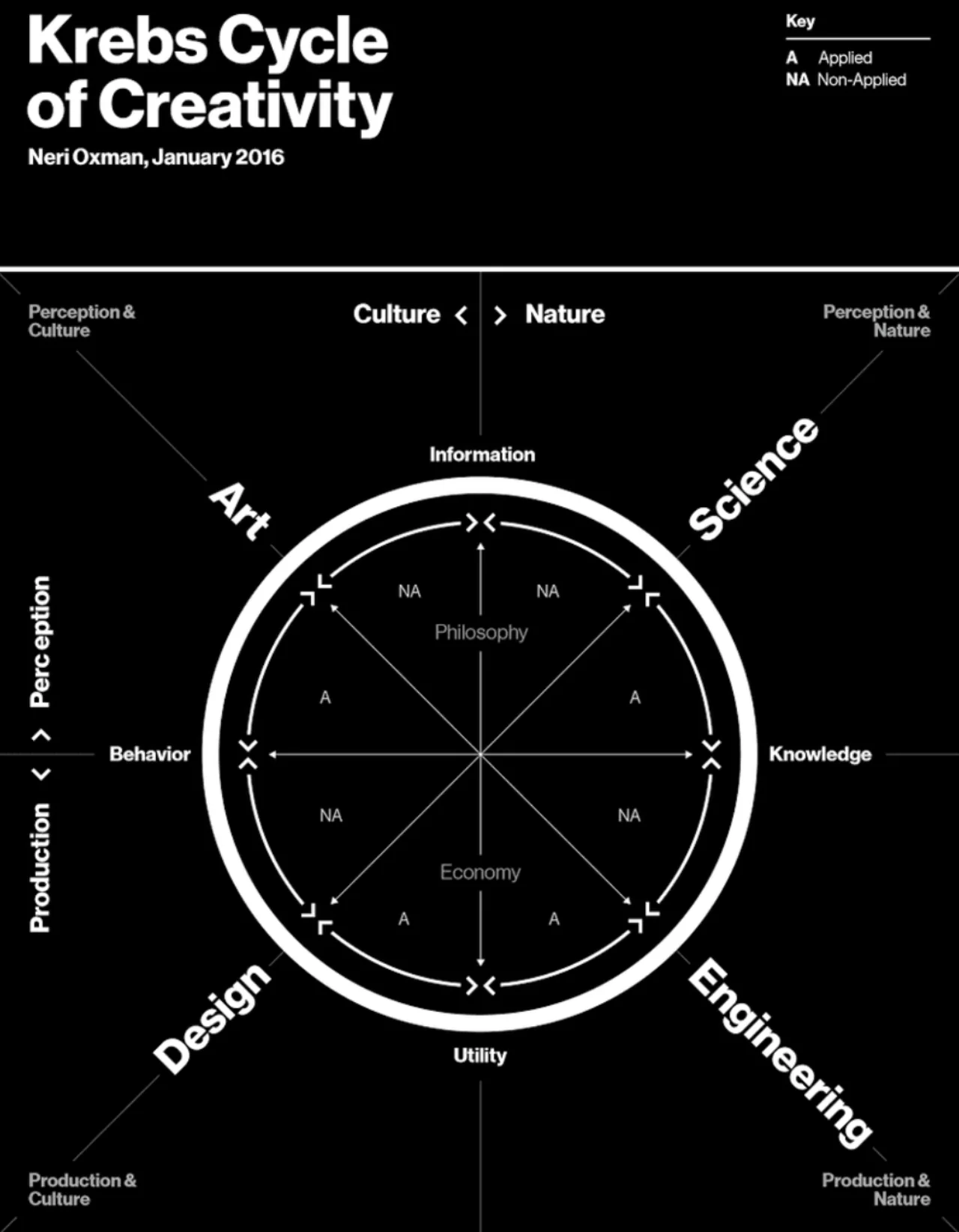
The role of Science is to explain and predict the world around us; it ‘converts’ information into knowledge. The role of Engineering is to apply scientific knowledge to the development of solutions for empirical problems; it ‘converts’ knowledge into utility. The role of Design is to produce embodiments of solutions that maximize function and augment human experience; it ‘converts’ utility into behavior. The role of Art is to question human behavior and create awareness of the world around us; it ‘converts’ behavior into new perceptions of information, re-presenting the data that initiated the KCC in Science. At this ‘Cinderella moment’—when the hands of the KCC strike midnight—new perception inspires new scientific exploration. For example, in As Slow as Possible, John Cage transports the listener into a state where space and time are stretched, offering a personal interpretation of time dilation and questioning the nature of space-time itself.
The Moral Bucket List
Commencement speakers are always telling young people to follow their passions. Be true to yourself. This is a vision of life that begins with self and ends with self. But people on the road to inner light do not find their vocations by asking, what do I want from life? They ask, what is life asking of me? How can I match my intrinsic talent with one of the world’s deep needs?
Their lives often follow a pattern of defeat, recognition, redemption. They have moments of pain and suffering. But they turn those moments into occasions of radical self-understanding — by keeping a journal or making art. As Paul Tillich put it, suffering introduces you to yourself and reminds you that you are not the person you thought you were.
The people on this road see the moments of suffering as pieces of a larger narrative. They are not really living for happiness, as it is conventionally defined. They see life as a moral drama and feel fulfilled only when they are enmeshed in a struggle on behalf of some ideal.
This is a philosophy for stumblers. The stumbler scuffs through life, a little off balance. But the stumbler faces her imperfect nature with unvarnished honesty, with the opposite of squeamishness. Recognizing her limitations, the stumbler at least has a serious foe to overcome and transcend. The stumbler has an outstretched arm, ready to receive and offer assistance. Her friends are there for deep conversation, comfort and advice.
External ambitions are never satisfied because there’s always something more to achieve. But the stumblers occasionally experience moments of joy. There’s joy in freely chosen obedience to organizations, ideas and people. There’s joy in mutual stumbling. There’s an aesthetic joy we feel when we see morally good action, when we run across someone who is quiet and humble and good, when we see that however old we are, there’s lots to do ahead.
The stumbler doesn’t build her life by being better than others, but by being better than she used to be. Unexpectedly, there are transcendent moments of deep tranquillity. For most of their lives their inner and outer ambitions are strong and in balance. But eventually, at moments of rare joy, career ambitions pause, the ego rests, the stumbler looks out at a picnic or dinner or a valley and is overwhelmed by a feeling of limitless gratitude, and an acceptance of the fact that life has treated her much better than she deserves.
Those are the people we want to be.
The Gift
In every tragedy, there is a gift, if we are able to see and accept it. From my brother, I received a personal understanding of death, and a constant reminder to live my life as though it may end at any moment. From my daughter, I learned what it means to love unconditionally, without expecting anything in return, a true gift.
These gifts were delivered at great cost, but still I often struggle to retain them. Life gets busy, and I forget what matters. But the reminders are all around us, if only we can open our eyes.
Happiness Is Peace in Motion
Here’s a phrase I like: “Peace is happiness at rest; happiness is peace in motion.” Someone who’s peaceful at rest will end up happy when they do an activity. While a happy person sitting idle will be peaceful. The ultimate goal is not happiness, even though we use that term a lot. The goal is peace.
You cannot achieve peace directly or even work toward it. Rather, you can work toward understanding. There’s an old Sikh saying, “The name of God is truth.” When you understand certain things and they become a part of you, you naturally become a more peaceful person.
Blogs & Websites
Influential
Bret Victor
Bret Victor's works have inspired me a lot about the potential of computers from a human-computer interaction perspective. Here's my summary of his thoughts:
Ideas live in representations, and representations have to live in a medium. A medium is a tool that allows us to use our human capabilities to create representations we need. The existing media are not able to unlock the full potential of human capabilities, nor can they generate representations that we need to explore complex systems.
The computer, with its computational, responsive, and connected traits, has the potential to become a new dynamic medium. But right now, we are only putting old forms of representations on this new medium. Of all the many capabilities and ways of thinking that we have, we only use fingers and linguistic thinking to interact with computers.
What we need to do is to develop representations that can only exist in this new medium, and develop a new form of intellectual work based on it that naturally incorporates the body and uses the body in the way that the body has always been meant to be used.
Paul Graham
I started reading Paul's essays in high school. In addition to his insight into startups, many of his perspectives on things are also worth looking at. Here are some of his best pieces and how they affected me:
Perspective on Life and Decisions
Life is Short
I used to like debating people when I was in high school. I realized that most of those debates were a waste of time, so now I no longer defend myself, and I have more time to focus on important things.
When you ask adults what they got wrong at that age, nearly all say they cared too much what other kids thought of them.
When someone contradicts you, they're in a sense attacking you. Your instinct when attacked is to defend yourself. But like a lot of instincts, this one wasn't designed for the world we now live in. Counterintuitive as it feels, it's better most of the time not to defend yourself. Otherwise these people are literally taking your life.
Cultivate a habit of impatience about the things you most want to do. Don't wait before climbing that mountain or writing that book or visiting your mother. You don't need to be constantly reminding yourself why you shouldn't wait. Just don't wait.
Relentlessly prune bullshit, don't wait to do things that matter, and savor the time you have. That's what you do when life is short.
Cities and Ambition
One of the reasons I chose to go to Minerva is that we have to live in seven cities during the four years, including San Francisco, Seoul, Hyderabad, Berlin, Buenos Aires, London, and Taipei. It gave me the opportunity to feel the messages from different cities.
Not all cities send a message. Only those that are centers for some type of ambition do. New York tells you: you should be richer. Boston is that the message there is: you should be smarter. The message Berkeley sends is: you should live better. The message Silicon Valley sends is: you should be more powerful. Cambridge as a result feels like a town whose main industry is ideas, while New York's is finance and Silicon Valley's is startups.
Unless you're sure what you want to do and where the leading center for it is, your best bet is probably to try living in several places when you're young. You can never tell what message a city sends till you live there, or even whether it still sends one.
Some people know at 16 what sort of work they're going to do, but in most ambitious kids, ambition seems to precede anything specific to be ambitious about. They know they want to do something great. They just haven't decided yet whether they're going to be a rock star or a brain surgeon. There's nothing wrong with that. But it means if you have this most common type of ambition, you'll probably have to figure out where to live by trial and error. You'll probably have to find the city where you feel at home to know what sort of ambition you have.
What You'll Wish You'd Known
The idea of "Stay Upwind" has always been my way of making decisions. That's part of the reason that I majored in physics and mathematics at NTU and later studied computational science at Minerva.
Suppose you're a college freshman deciding whether to major in math or economics. Well, math will give you more options: you can go into almost any field from math. If you major in math it will be easy to get into grad school in economics, but if you major in economics it will be hard to get into grad school in math. Flying a glider is a good metaphor here. Because a glider doesn't have an engine, you can't fly into the wind without losing a lot of altitude. If you let yourself get far downwind of good places to land, your options narrow uncomfortably. As a rule you want to stay upwind. So I propose that as a replacement for "don't give up on your dreams." Stay upwind.
I also agree a lot with "The way to get a big idea to appear in your head is not to hunt for big ideas, but to put in a lot of time on work that interests you." Though I am ambitious about inventing the future, I spend most of my time researching the subjects that I am interested in.
If it takes years to articulate great questions, what do you do now, at sixteen? Work toward finding one. Great questions don't appear suddenly. They gradually congeal in your head. And what makes them congeal is experience. So the way to find great questions is not to search for them-- not to wander about thinking, what great discovery shall I make? You can't answer that; if you could, you'd have made it. The way to get a big idea to appear in your head is not to hunt for big ideas, but to put in a lot of time on work that interests you, and in the process keep your mind open enough that a big idea can take roost. Einstein, Ford, and Beckenbauer all used this recipe. They all knew their work like a piano player knows the keys. So when something seemed amiss to them, they had the confidence to notice it.
How to Do What You Love
This article explained the reason why I have kept exploring different fields in the past few years. I don't want to make a rash decision when it affects my whole life.
Almost anyone would rather, at any given moment, float about in the Carribbean, or have sex, or eat some delicious food, than work on hard problems. The rule about doing what you love assumes a certain length of time. It doesn't mean, do what will make you happiest this second, but what will make you happiest over some longer period, like a week or a month.
Prestige is especially dangerous to the ambitious. If you want to make ambitious people waste their time on errands, the way to do it is to bait the hook with prestige. That's the recipe for getting people to give talks, write forewords, serve on committees, be department heads, and so on. It might be a good rule simply to avoid any prestigious task. If it didn't suck, they wouldn't have had to make it prestigious.
"Always produce" is a heuristic for finding the work you love. If you subject yourself to that constraint, it will automatically push you away from things you think you're supposed to work on, toward things you actually like. "Always produce" will discover your life's work the way water, with the aid of gravity, finds the hole in your roof.
Don't decide too soon. Kids who know early what they want to do seem impressive, as if they got the answer to some math question before the other kids. They have an answer, certainly, but odds are it's wrong. You won't want to have a life chosen for you by a high-school kid. Unless you're fairly sure what you want to do, your best bet may be to choose a type of work that could turn into either an organic or two-job career. That was probably part of the reason I chose computers.
Keep Your Identity Small
When I graduated from high school, I had several labels. At the moment I decided to drop out of college, I let go of all those labels and became more honest with myself.
I think what religion and politics have in common is that they become part of people's identity, and people can never have a fruitful argument about something that's part of their identity. The more labels you have for yourself, the dumber they make you.
How to Lose Time and Money
I believe the best way of managing time is not to reduce all the relaxing time, but to spend time on the right things.
The way most fortunes are lost is not through excessive expenditure, but through bad investments. The most dangerous way to lose time is not to spend it having fun, but to spend it doing fake work. With time, as with money, avoiding pleasure is no longer enough to protect you.
How to Be an Expert in a Changing World
There was a time when I believed what the experts said, until I read this article, and now I'm more cautious about accepting information.
When experts are wrong, it's often because they're experts on an earlier version of the world.
Instead of trying to point yourself in the right direction, admit you have no idea what the right direction is, and try instead to be super sensitive to the winds of change. The way to come up with new ideas is not to try explicitly to, but to try to solve problems and simply not discount weird hunches you have in the process.
Surround yourself with the sort of people new ideas come from. If you want to notice quickly when your beliefs become obsolete, you can't do better than to be friends with the people whose discoveries will make them so.
Perspective on Other Stuff
How to do Philosophy
The way of doing philosophy mentioned in this article is one of the core purposes of my writing.
These seem to me what philosophy should look like: quite general observations that would cause someone who understood them to do something differently.
Getting to general plus useful by starting with useful and cranking up the generality may be unsuitable for junior professors trying to get tenure, but it's better for everyone else, including professors who already have it. This side of the mountain is a nice gradual slope. You can start by writing things that are useful but very specific, and then gradually make them more general. Joe's has good burritos. What makes a good burrito? What makes good food? What makes anything good? You can take as long as you want. You don't have to get all the way to the top of the mountain. You don't have to tell anyone you're doing philosophy.
This argument seems to me like someone in 1500 looking at the lack of results achieved by alchemy and saying its value was as a process. No, they were going about it wrong. It turns out it is possible to transmute lead into gold (though not economically at current energy prices), but the route to that knowledge was to backtrack and try another approach.
The Risk of Discovery
This article reminds me that no matter how good you are, you always have to face the risk.
Physics seems to us a promising thing to work on, and alchemy and theology obvious wastes of time. But that's because we know how things turned out. In Newton's day the three problems seemed roughly equally promising. Newton made three bets. One of them worked. But they were all risky.
How art can be good
For a while I was confused about what art was. This article gave me a lot of inspiration.
If we were talking about the taste of apples, I'd agree that taste is just personal preference. Some people like certain kinds of apples and others like other kinds, but how can you say that one is right and the other wrong?
The thing is, art isn't apples. Art is man-made. It comes with a lot of cultural baggage, and in addition the people who make it often try to trick us. Most people's judgement of art is dominated by these extraneous factors; they're like someone trying to judge the taste of apples in a dish made of equal parts apples and jalapeno peppers. All they're tasting is the peppers. So it turns out you can pick out some people and say that they have better taste than others: they're the ones who actually taste art like apples.
In fact, one of the reasons artists in fifteenth century Florence made such great things was that they believed you could make great things. So the most important consequence of realizing there can be good art is that it frees artists to try to make it. There is such a thing as good art, and if you try to make it, there are people who will notice.
What I've Learned from Hacker News
This specific quote encouraged me to look at the flaws of the current world and try to change it. Its idea is similar to Bret Victor's final quote in Stop Drawing Dead Fish.
When a technology is young, the existing solutions are usually terrible; which means it must be possible to do much better; which means many problems that seem insoluble aren't. It's important to remember we're trying to solve a new problem, because that means we're going to have to try new things, most of which probably won't work.
Six Principles for Making New Things
It provides a useful and elegant standard process to make new things.
I like to find (a) simple solutions (b) to overlooked problems (c) that actually need to be solved, and (d) deliver them as informally as possible, (e) starting with a very crude version 1, then (f) iterating rapidly.
Why Smart People Have Bad Ideas
I participated in the Physics Olympiad in high school and became very good at solving problems. However, I realized choosing the right problem is equally or even more important than solving problems. So I stopped participating in competitions and spent more time feeling the essence and beauty of knowledge.
I think the problem with many, as with people in their early twenties generally, is that they've been trained their whole lives to jump through predefined hoops. They've spent 15-20 years solving problems other people have set for them. And how much time deciding what problems would be good to solve? Two or three course projects? They're good at solving problems, but bad at choosing them.
Blogs
Wait But Why
Wait But Why provides me with many new ways of seeing the world, doing things, and making decisions. I was deeply inspired by The Artificial Intelligence Revolution Series and The Elon Musk Post Series, which made me excited about the future of humankind and amazed by human capabilities.